BSc Dissertation · AI / Machine Learning
Cybersecurity Incident Classification — NLP, ML & MITRE ATT&CK
Research and evaluation of an AI-assisted cybersecurity incident-classification pipeline using text features, transformer embeddings, structured security metadata, and ensemble machine-learning models.
BSc dissertation / research projectContext & Scope
This project was developed as part of my BSc (Hons) Cyber Security dissertation. It investigates how NLP and machine-learning techniques can support security incident classification and triage. It is a research prototype and is not presented as a production SOC automation platform.
Objective
Develop and evaluate a reproducible incident-classification pipeline that combines textual and structured security features, compare multiple machine-learning models, and assess their potential relevance to security triage workflows.
Research Approach
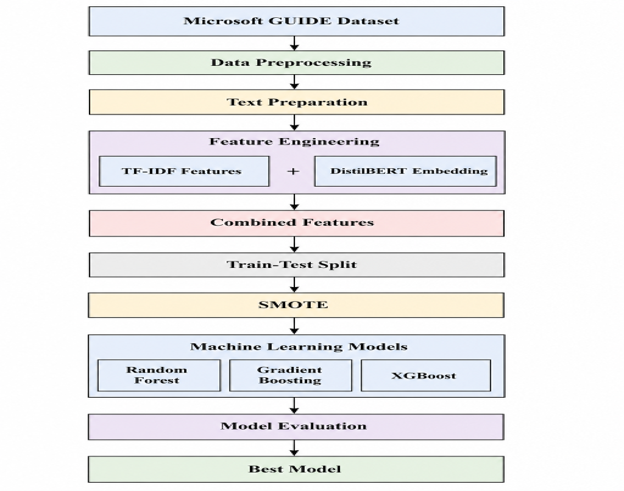
- Prepared a working research subset of 50,000 cybersecurity incident records from the Microsoft GUIDE dataset.
- Combined TF-IDF text representations, Sentence Transformer embeddings, and structured security metadata into a hybrid feature pipeline.
- Used SMOTE as part of the experimental workflow to address class imbalance.
- Benchmarked Random Forest, Gradient Boosting, and XGBoost classifiers.
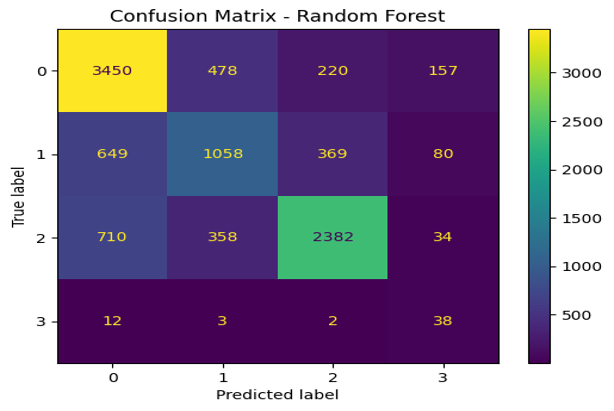
- Evaluated model behaviour using accuracy, weighted F1-score, cross-validation, confusion matrices, ROC analysis, precision-recall analysis, and feature importance.
- Used MITRE ATT&CK context to support security-oriented interpretation of incident categories and model output.
Key Results
- The experimental dataset contained 50,000 security incident records.
- The engineered hybrid representation contained 694 features.
- Three ensemble machine-learning classifiers were evaluated.
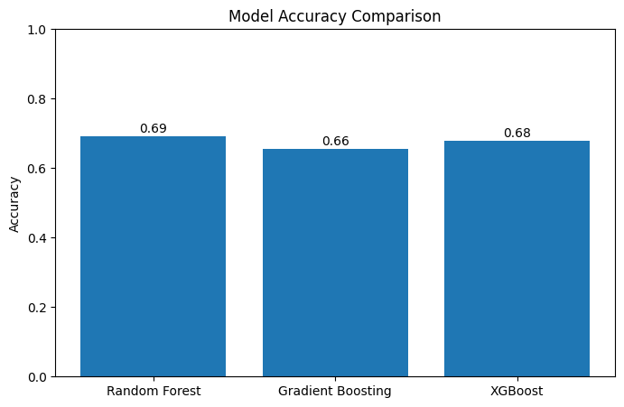
- Random Forest achieved the strongest reported test accuracy at 69.28%.
- Random Forest achieved a weighted F1-score of 0.6963.
- Reported cross-validation accuracy for the strongest model was 75.96%.
Research Evidence
Selected figures from the original BSc dissertation experiment. These results represent research evaluation, not production SOC performance.
Research Boundary
The results come from an academic research pipeline evaluated on a prepared dataset. They do not demonstrate production deployment, autonomous SOC decision-making, or operational performance against live enterprise incidents.
Security Relevance
The project demonstrates security-data preparation, NLP feature engineering, transformer-based representations, class-imbalance handling, model comparison, performance evaluation, MITRE ATT&CK-aware analysis, and critical assessment of AI-assisted security triage.